The Rise of Identity and the Long War for Spain (800–1492)
At the dawn of the 9th century, the Iberian Peninsula was a land fractured by conquest and cultural divergence. Following the Umayyad invasion in 711, nearly the entire peninsula had come under Muslim rule, forming the powerful and advanced society of Al-Andalus. Yet even as the Caliphate of Córdoba flourished, a persistent resistance held on in the rugged mountains of the north. The Christian peoples who remained there—Asturians, Cantabrians, Basques, and Galicians—maintained not only their faith, but the idea that they, too, had a rightful claim to the land of Spain. Over time, this idea would evolve into a civilizational mission—one not merely of resistance, but of restoration, redemption.
[Speaking of redemption: Good News Aryans, the Tide is Turning!]
Foundations of Resistance: The 9th Century
In the early 800s, the Christian Kingdom of Asturias was already expanding slowly into formerly Visigothic lands under the rule of Alfonso II and Alfonso III. These kings, especially the latter, began repopulating the Duero Valley with Christian settlers, laying the groundwork for the later Repoblación strategy. Christian identity during this period was deeply tied to the memory of the Visigothic kingdom and its Catholic heritage, a heritage invoked to justify war and establish continuity. In the south, meanwhile, the Emirate of Córdoba represented a powerful and culturally rich Islamic world that towered over the small Christian realms. But the very existence of Asturias, and the later emergence of León, Navarre, and the County of Castile, laid the ideological and military foundations for the Reconquista.
The Challenge of the Caliphate: The 10th Century
The 10th century was dominated by the rise of the Caliphate of Córdoba, declared by Abd al-Rahman III in 929, transforming Al-Andalus into the most powerful Islamic state in Western Europe. Its capital became a beacon of science, art, and architecture, dwarfing the Christian kingdoms to the north. Nonetheless, Christian leaders in León and Navarre continued to assert their independence and expanded their territories. The Count of Castile, initially a vassal of León, began to act with increasing autonomy, setting the stage for the rise of Castile as a power in its own right. Though overshadowed by Muslim supremacy, the Christians laid claim to a divine mandate and a shared Hispanic identity rooted in the old Gothic past.
Fragmentation and Advance: The 11th Century
In 1031, the Caliphate of Córdoba collapsed into a series of smaller taifas—city-state kingdoms ruled by Muslim warlords. This fragmentation gave the Christian kingdoms a critical advantage.
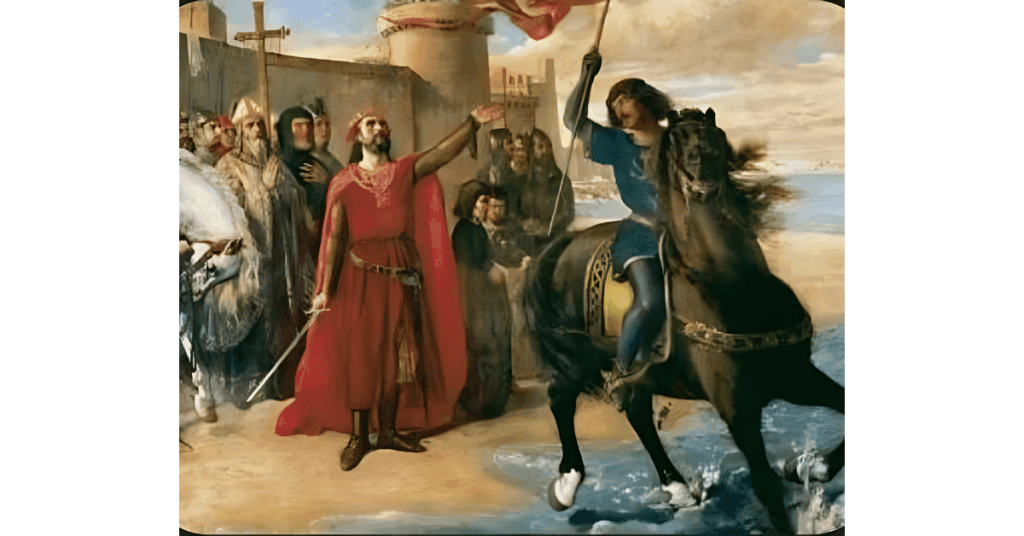
Castile under Ferdinand I and León under his successors expanded southward. Aragon also began its ascent under Sancho Ramírez. The famed warrior El Cid, a knight of noble lineage who served both Christian and Muslim rulers, epitomized the era’s fluid allegiances and martial prowess. The conquest of Toledo in 1085 by Alfonso VI of Castile was a turning point, briefly making Castile the dominant power in Spain. Alarmed by Christian gains, the Muslim taifas called upon the Almoravids from North Africa, who crossed the Strait of Gibraltar and re-imposed Islamic unity by force, halting Christian expansion for a generation.
The Tide Turns: The 12th Century
Despite the temporary setback brought by the Almoravids, Christian momentum resumed in the 1100s. The Kingdom of Portugal emerged as an independent Christian state in 1139 following the victory of Afonso Henriques at the Battle of Ourique. The Almoravids were soon displaced by the Almohads, a more radical North African Islamic dynasty. Christian forces, increasingly driven by crusading zeal and papal support, intensified their campaigns.
Aragon pushed into the Ebro Valley, while Castile and León alternated between union and rivalry. Military orders such as the Knights of Santiago and Calatrava were founded to institutionalize the fight against Islam. The Reconquista was now seen not merely as a territorial war but as a divine mission to reclaim Christendom.
The Great Conquests: The 13th Century
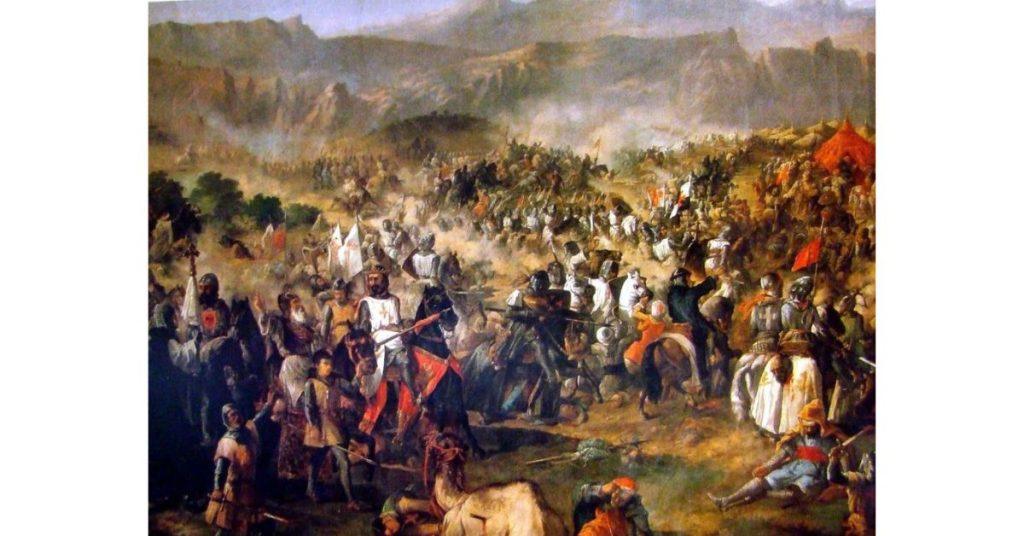
The Battle of Las Navas de Tolosa in 1212, led by a united Christian coalition, decisively broke Almohad power in Iberia. In the decades that followed, Castile under Ferdinand III conquered Córdoba (1236), Jaén (1246), and finally Seville (1248). James I of Aragon seized Valencia and the Balearic Islands. By the mid-century mark, only the Emirate of Granada remained under Muslim rule. The political map of Iberia now featured Castile-León, Portugal, Aragon, and Navarre as consolidated Christian kingdoms. The population of Muslim subjects—Mudéjares—grew significantly, creating complex dynamics in the newly conquered cities. Efforts to repopulate these areas with Christian settlers continued. The Reconquista entered a new phase: less war, more statecraft.
If you would like to continue reading this article, please consider purchasing the magazine issue it’s featured in.
Support Aryan businesses by purchasing Arditi Issue No. IV: “A Season For Rebuilding What Was Lost”. Featuring 6 new articles and cover art by MG42, this magazine is packed with the blood, sweat, and tears of our Aryan brothers and sisters.

Don’t miss out on your chance to join Arditi’s Telegram Channel!