
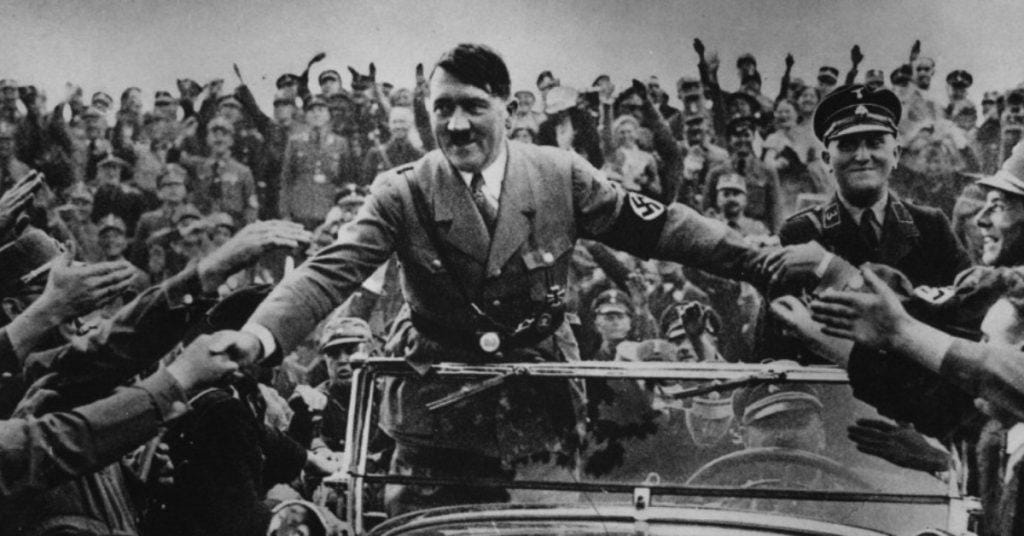
My thoughts on Han’s Schmidt’s “Living in Hitler’s Germany.”
Hans Schmidt lived through this period, which we are told is abundantly documented (in the negative sense), but when it comes to showing reality, the contradiction and distortion of the “documents” is absurd, so much so that one can take and create the most biased story, full of unfounded speculations, through these “facts” and “documents”. An example that illustrates this is the lie that Hitler had left the Berlin stadium after Jesse Owens’ victory in the Olympics, because this would “prove” the “equality of the human races;” well, on the one hand this fact proves racial egalitarianism, on the other, the German victory in the Olympics with 36 gold medals proves Hitler’s idea, so the real fact was hidden and the lie propagated based on a falsehood, because Hans Schmidt shows that Jesse Owens was already considered a favorite in his sport and there were not even any negative mentions about him in the German newspapers of the time. A very common falsehood, spread in an excessively crude way by George Orwell in his 1984, is that through the Hitler Youth, young people snitch on their parents and hand them over to die in the KZs. Well, this was frowned upon by the aforementioned organization, as Hans Schmidt tells us.

The aforementioned author also says that at that time people were happy and united, they felt that they belonged to an organic body, which explains the problem that historians encounter in conceptualizing the very notion of state and economy for the National Socialists.
From now on, we will also work with the Brazilian economist Ricardo Luís Chaves Feijó and his essay: “An interpretation of the First German Economic Miracle (1933-1944)”. His conclusion about the German regime is clear: more efficient than the communist planned economy, as well as a peace economy in times of war with two main axes, the first: the eradication of unemployment, the second, rearmament. The two axes were completed without having to sacrifice one to the detriment of the other (food on the table versus the army).
Hans Schmidt tells us that Germany suffered from a shortage of workers, such was the success of its First Four-Year Plan (not named in Schmidt’s report, but as described in Feijó’s essay). During this period, the Autobahn was built, a network of roads connecting all of Germany, with minimal degradation of the environment and also minimal levels of corruption. Much was invested in construction, a fact that attests to Hans Schmidt’s statement that it was very cheap to buy a house in Germany, as well as subsidized loans (interest-free) for newlyweds who were going to live together.
With regard to the enterprise, private property, etc., was permitted, but commanded in the language used by the Brazilian author. There was no confiscation of property or even socialization of companies, a fact also attested by Hans Schmidt. However, the analysis by historians, which is summarized in Feijó’s essay, goes further and has difficulty conceptualizing “how” the “Nazis” managed to combine distinct ideas, such as central government and free enterprise. What they themselves confess is the existence of an economically decentralized government, not totalitarian but authoritarian, which, while controlling prices and wages, managed, as if by magic, to keep these “agents” united, and by “agents” here we refer to large German companies, “cartelized” to provide an extremely functional economy, superior to the Soviet one and, the authors do not say, also superior to the capitalists. The only answer to this is not only racial unity, which makes parts integrate into a whole, but also ideological unity, which in this sense was an “invisible hand” guiding the parts to compose the common objective: the safeguarding of an entire race.
If you liked this article, please consider purchasing the magazine issue it’s featured in.
 Arditi Magazine No. IV: A Season For Rebuilding What Was Lost.

Don’t miss out on your chance to join Arditi’s Telegram Channel!
Join our public Telegram broadcast channel in order to stay up to date with all of our projects and Arditi content. You can even apply to join the New Way movement by following one of our application links featured in the Telegram channel.


